
Sloped and vaulted ceilings have the potential to be spectacular — cathedral-like, sculptural, atmospheric. But they also come with lighting challenges: uneven angles, skylights, shallow voids, awkward pitches, multi-level ceilings, and reduced mounting options.
This guide explains the problems, the why, and — most importantly — the solutions to getting the lighting right in a room with a sloped ceiling.
Written with the LightingCompany.co.uk design ethos in mind, this is a practical and inspirational handbook for homeowners, designers, and renovators to guide you in how to light a sloped ceiling effectively for everyday living.

Understanding the Architecture Before You Choose Any Light
Sloped ceilings vary dramatically, and the lighting must respond to the architecture, not the other way around.
Common architectural situations include:
- A single straight pitch
- A pitch leading into a flat ceiling section
- Different ceiling heights at each end of the room
- Dormers interrupting the slope
- Skylights cutting through the roofline
- Very tall vaulted spaces with large voids
- Angled ceilings with no ceiling void behind (restricting recessed fittings)

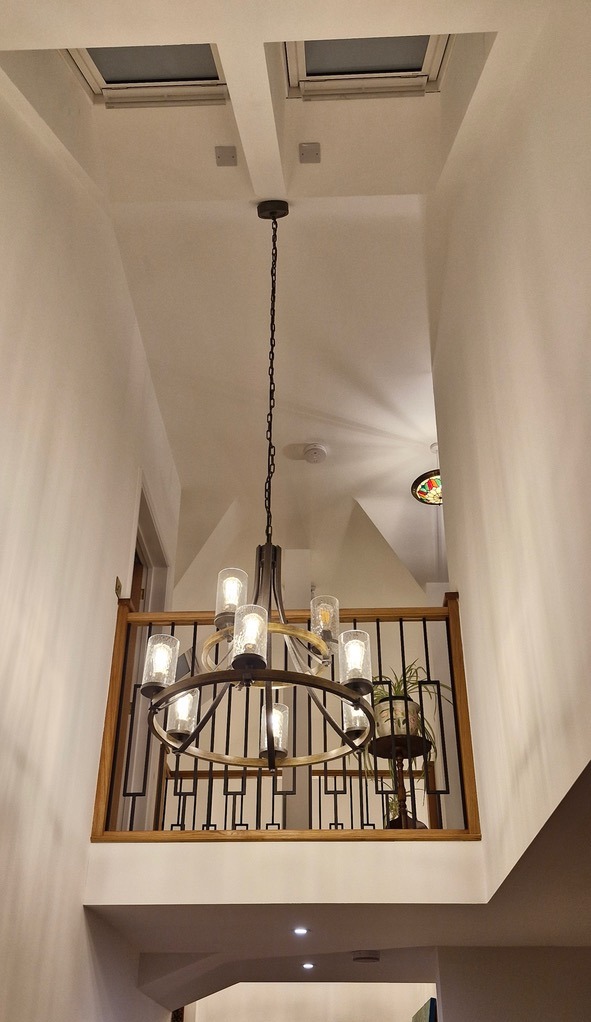
Before you choose a single fitting, you must understand:
- The slope angle – Steep slopes cause shadows and glare if lights are aimed incorrectly.
- Available horizontal planes – These determine where flush or semi-flush lights can go. These fittings can ONLY be installed on a flat, horizontal section of ceiling.
- Ceiling void depth – Sloped and vaulted ceilings often have little or no recess space because insulation fills the structure — making recessed downlights impossible.
- Sightlines & symmetry – A pendant centred on a floor plan may not be centred on the ceiling.
Understanding these parameters stops you from choosing fittings that simply won’t work in the space.

The Challenge: Skylights Restrict Mounting Points
Skylights are wonderful for daylight — but they severely limit where a ceiling fixture can be placed.
Common problems caused by skylights:
- No central place left to mount a pendant
- The skylight steals vertical space needed for a fixture
- Night-time creates a dark “void” under the skylight
- Pendants hung too close visually fight the window
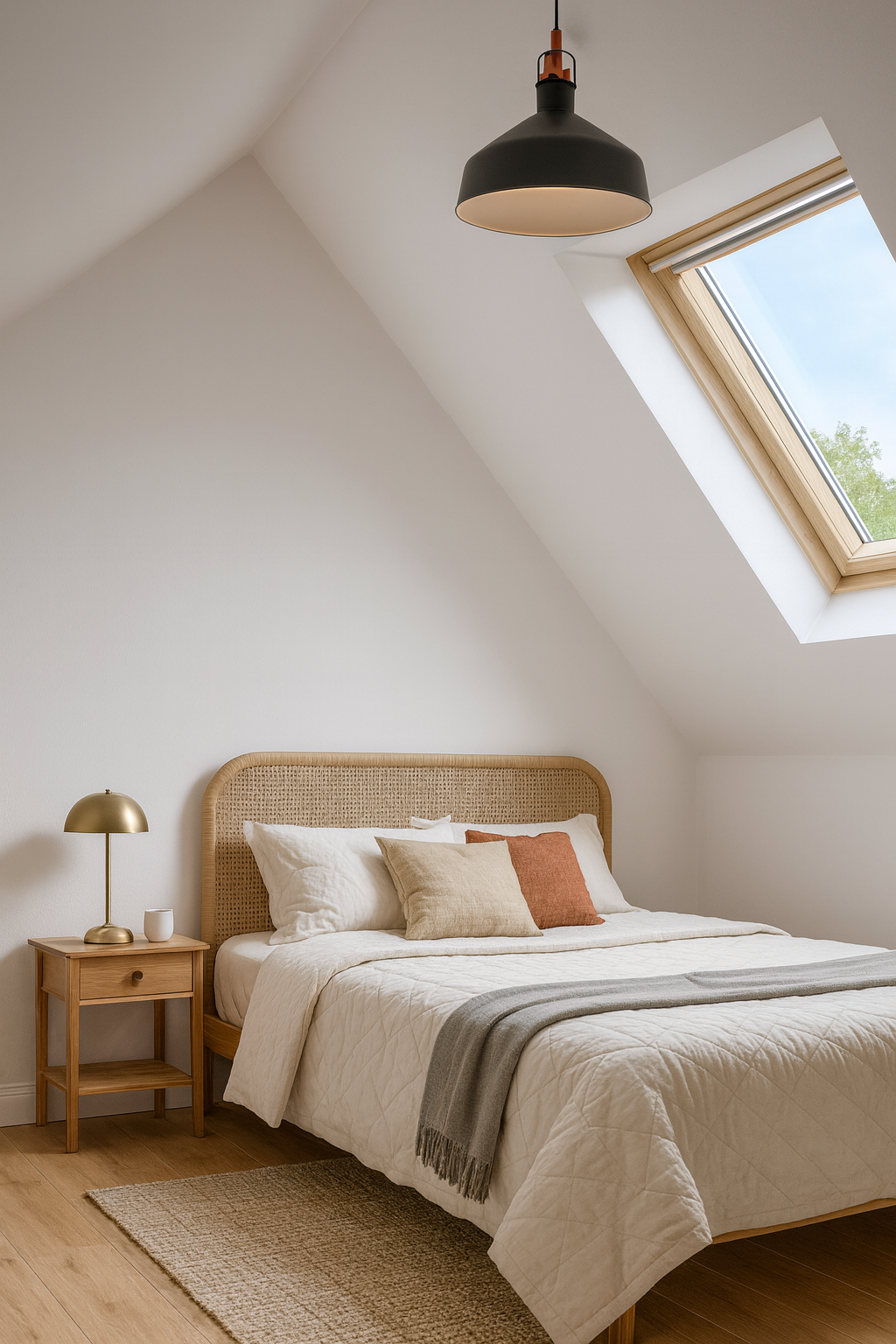
Professional solutions:
- Position pendants BETWEEN skylight bays, never directly beneath a roof window.
- Direct a pendant straight down if it MUST sit below a skylight. This avoids glare bouncing off the glass and grounds the fitting.
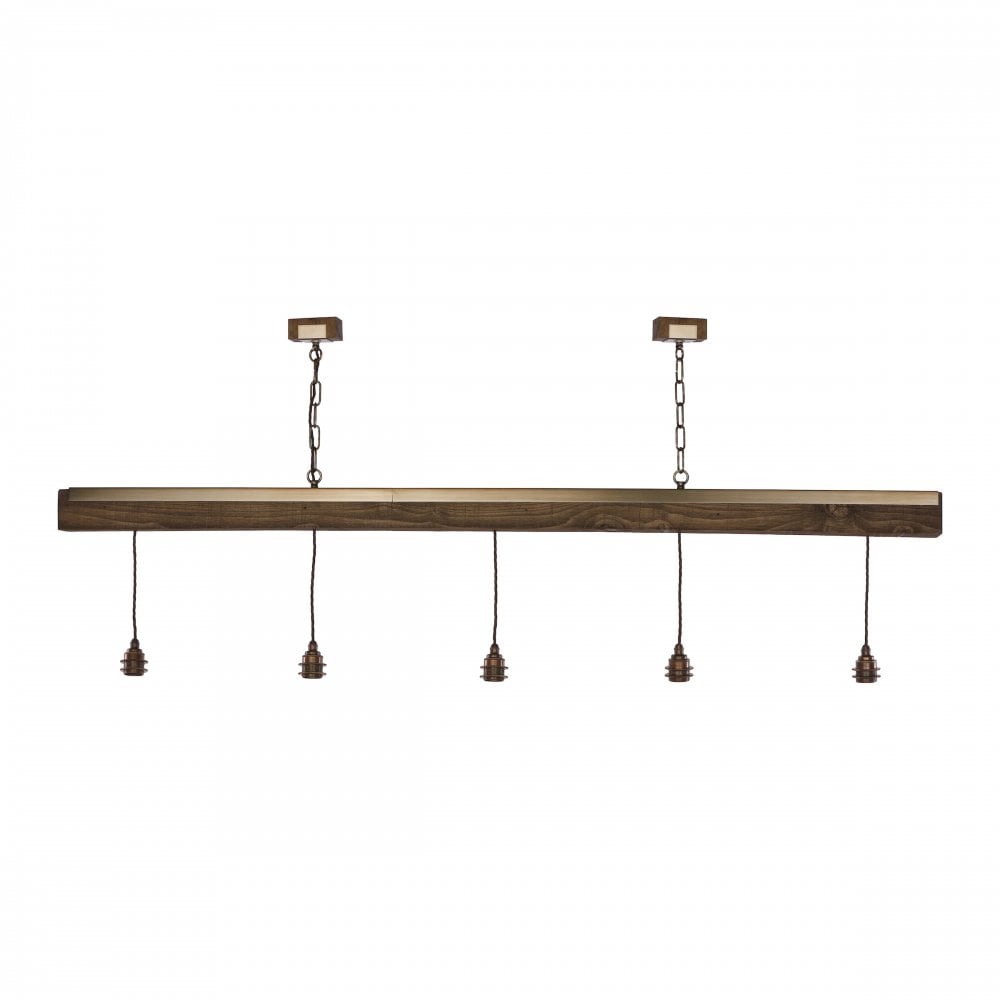
- Use a horizontal light fixture suspended between two chains. This is one of the BEST solutions and rarely discussed. Why it works: It spans the skylight bay without interfering with it; Each chain can be shortened independently; Perfect for uneven ceiling heights; Creates level lighting in a non-level space; And offers practical downward illumination where needed (kitchen, dining, island).
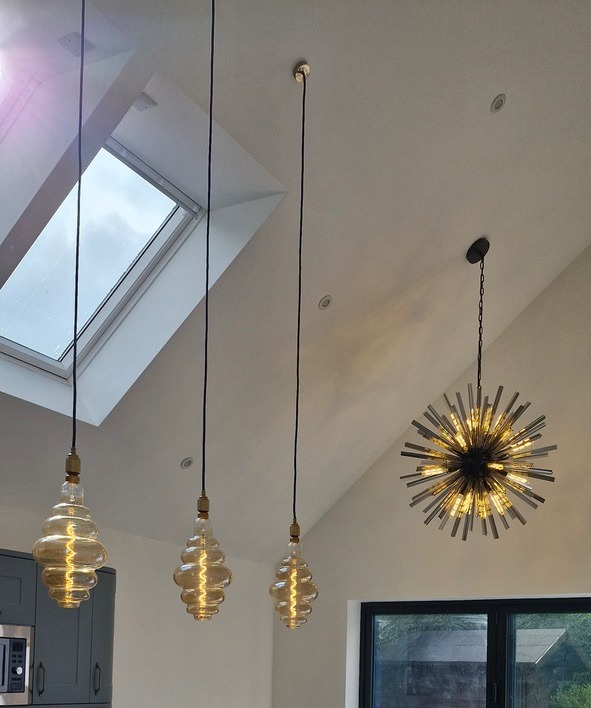
- Add wall lights or uplighters to balance the night-time contrast. A skylight becomes a black void after dark. Soft vertical light restores visual balance. Consider bespoke or customised pendant fittings.
- Skylights often dictate unique cable lengths or specific canopy position. Explore LightingCompany.co.uk for height adjustable fittings or speak to our experts about customising fittings.
The Challenge: Uneven or Multi-Level Ceilings – Consider How to Light a Room With Different Ceiling Heights
Renovated lofts, attic conversions and extended homes frequently have ceilings that:
- Rise high at one end, dip low at the other
- Mix slopes with flat areas
- Include partial dormers
- Feature off-centre ridge lines
- Change pitch multiple times
These spaces cannot be lit with a single, central ceiling light.
Professional solutions:
- Treat each ceiling surface as its own lighting zone. Use different fitting types on different planes.
- Use a linear suspended fixture across varying heights. Because each suspension point is adjustable, it can sit level even when the ceiling is not.
- Add up-lighting along beams or onto slopes. Unifies mixed ceiling heights visually.
- Layer light: Upper zone: statement pendant or chandelier; Mid zone: wall lights (scale appropriate!); Lower zone: floor lamps, table lamps. This prevents “bottom-heavy lighting” where only the furniture zone is illuminated.
- Use directional lights to correct awkward geometry. Angled spotlights or gimbal fittings allow you to point the light exactly where needed.
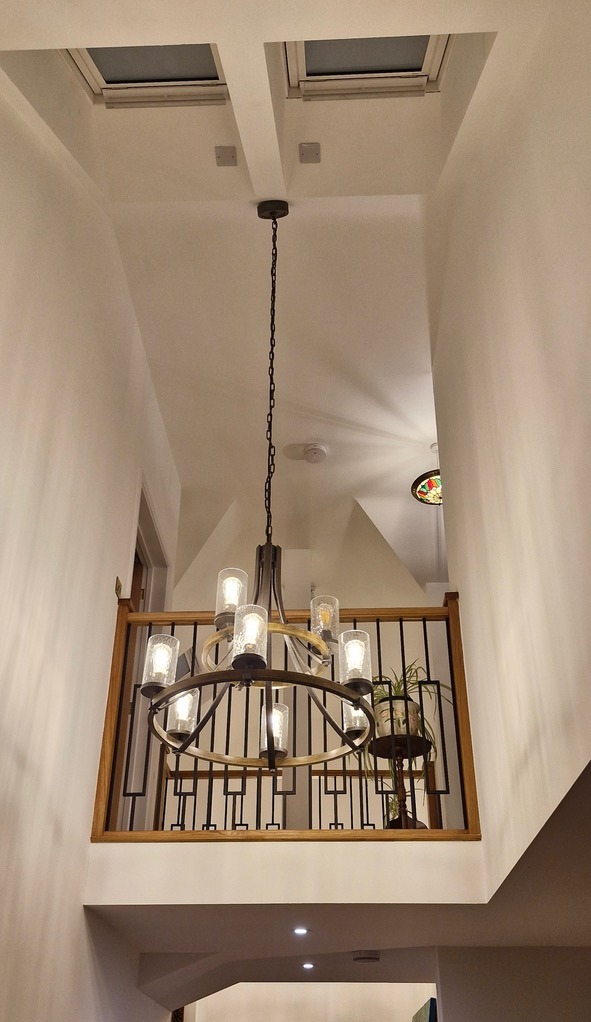
The Challenge: Recessed Lighting Isn’t Possible
Many homeowners assume they can use standard downlights — but sloped, vaulted or angled ceilings often make this impossible.
The technical reasons:
- They require a clear, empty void behind the ceiling
- That void must be deep enough for the driver, housing & fire can – most sloped roofs use that void for insulation
- Cutting into the structure compromises building performance
- Angled housings cause severe glare and beam misalignment
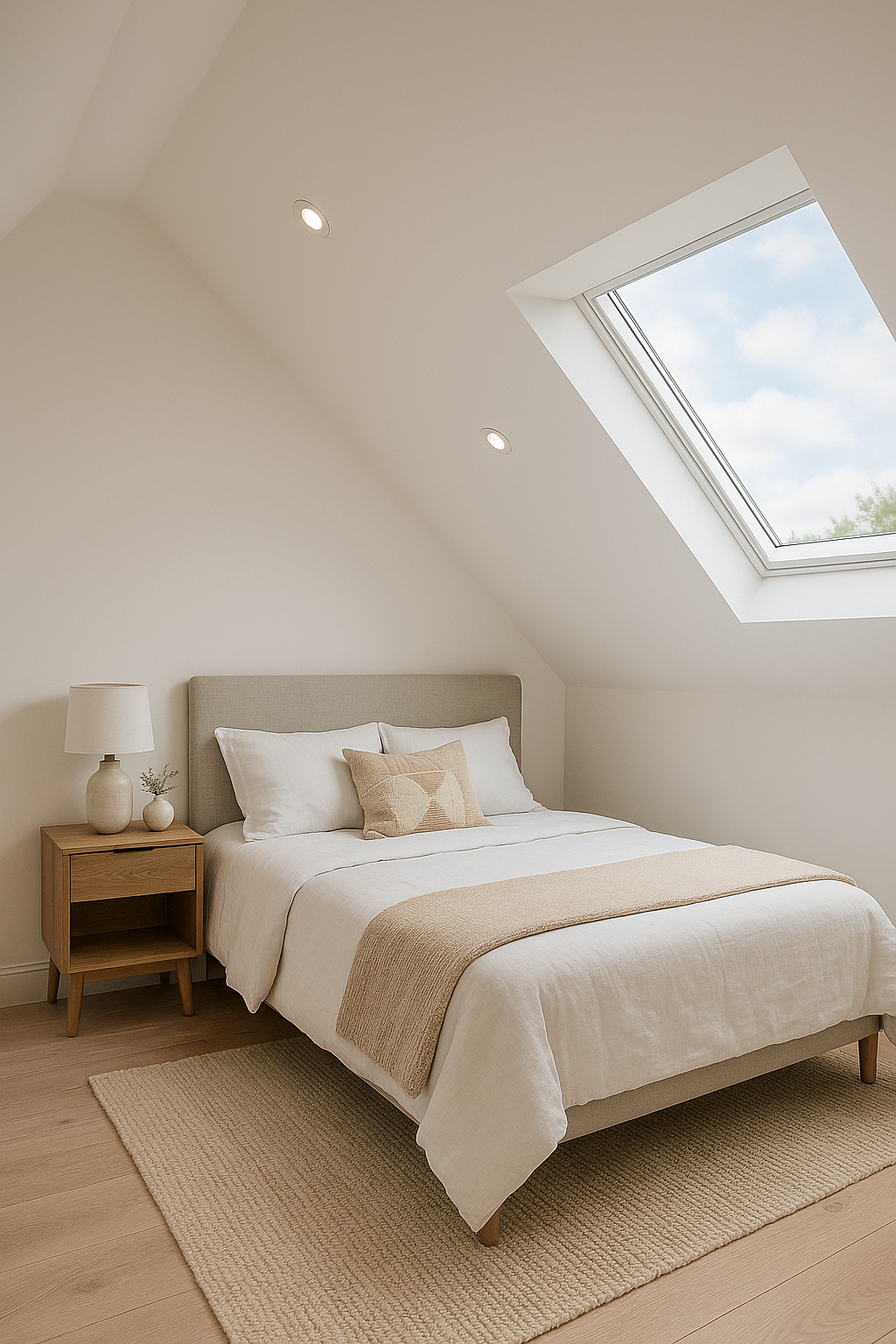
Professional solutions instead:
- Surface-mounted spotlights – Angle them to highlight walls, beams, art or work surfaces.
- Architectural uplighters – Bounce light onto the slope to visually lift the room.
- Pendant lights with directional bulbs – Good for kitchens and living spaces.
- Wall washers and picture lights – These create soft ambient fill-light in places ceilings cannot.
- Linear suspended fittings. Brilliant for task areas (islands, dining tables) and visually unify uneven ceilings.
Recessed lights are rarely the right answer — and in many sloped rooms, simply not possible.

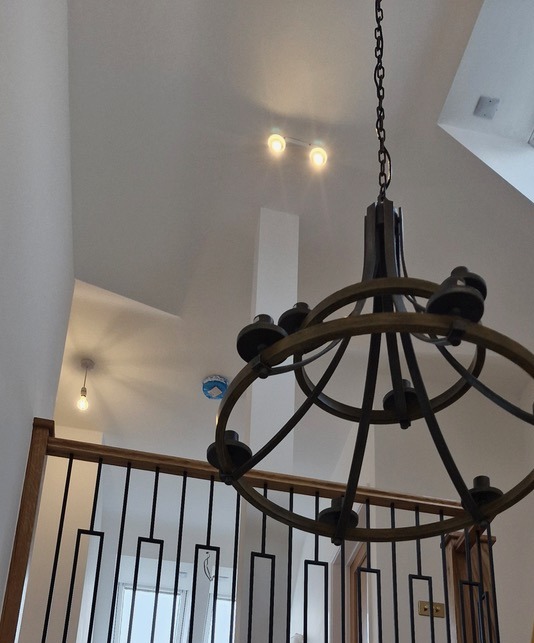
The Challenge: Pendants Interfering With the Slope
Let’s consider how to hang a pendant light on a sloped ceiling correctly. Pendant height and fixture width are critical under a slope.
Common issues:
- The shade or arm touches the slope
- The pendant looks “wedged in”
- A large pendant hung too high sits uncomfortably close to the pitch
Professional solutions:
- Hang pendants LOWER than usual. This ensures the fixture clears the slope.
- Consider the WIDTH of the pendant. The wider the fitting, the lower it must hang.
- Use slope-adapter canopies or flexible chain/cable drops. These allow pendants to hang vertically from an angled surface.
- Stagger multiple pendants down the slope. Perfect in kitchens or long vaulted spaces.
- For kitchen islands: Pendants must sit 75cm–95 cm above the counter, but this may need adjusting to avoid a clash with the slope.


The Challenge: Very Tall Rooms Need More Than One Light
Double-height rooms have enormous volume, meaning they swallow light. Here we look at how to light a tall room and why one pendant isn’t enough.
Problems in tall spaces:
- Illumination gets lost before it reaches the floor
- A standard pendant drop is far too short
- Light becomes uneven, with bright lower areas and dark upper voids
- Off-the-shelf fittings rarely come with long enough cables
Professional solutions:
- Multi-level lighting is mandatory. Upper lighting: chandelier or sculptural pendant; Mid-level: wall lights scaled LARGE enough for the space; Low-level: lamps for intimacy.
- Choose wall lights with real presence. If they’re too small, they vanish against the architecture.
- Consider bespoke or customised suspension lengths. LightingCompany.co.uk supplies lights with extended drops, multi-point suspensions or oversized fittings for tall rooms.
- Up light the roofline. This helps balance the vast vertical space and reduces “dead” zones.

The Challenge: Skylight Shadows at Night
Skylights become black voids at night, causing contrast problems and a sense of lost height. Let’s explore how to light a roof with skylights when the sun goes down.
Professional solutions:
- Use up lighting around the slopes. Softly illuminates the darkness where the skylight sits.
- Add wall lights opposite the skylight. Restores balance and prevents “dark wall syndrome.”
- Use pendants with downward-focused light. Good for dining, cooking or living room tasks under skylights.
- Linear fixtures across skylight bays. A highly underused technique — brilliant for open-plan rooms or kitchens.
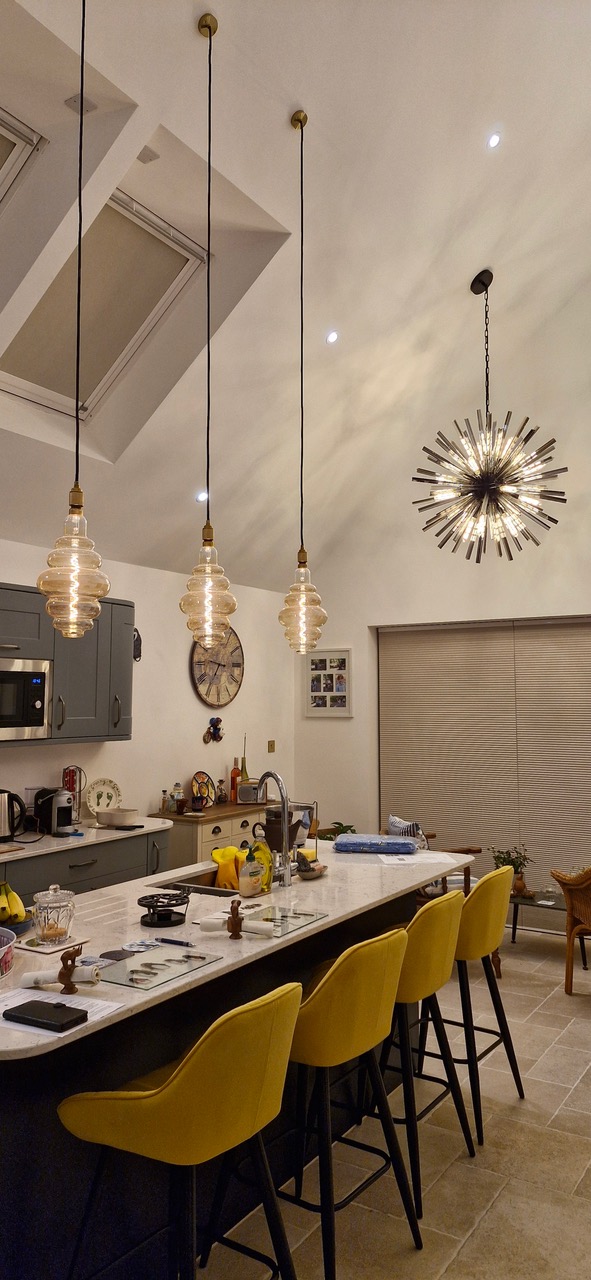
Choosing the Right Statement Lighting for Sloped Ceilings
A sloped ceiling LOVES a statement piece — modern or heritage. When considering how to light a sloped ceiling, look at the space and chose according to what’s available and fill it.
Best options:
- Heritage chandeliers (for cottages, barn conversions, period homes)
- Sculptural modern pendants (for monolithic or minimalist spaces)
- Multi-drop clusters (staircases, double-height halls)
- Wide linear fittings (kitchens, dining tables)
- Oversized ceiling sculptures (atriums, apexes)
This works because they fill the vertical space and anchor the room, creating visual order in a complex ceiling environment.


Full Checklist for How to Light a Sloped Ceiling
- Identify horizontal vs angled surfaces
- Locate skylights and structural beams
- Confirm ceiling void depth (don’t assume recessed lights are possible!)
- Measure pendant width + drop + slope clearance
- Plan multi-level lighting for tall rooms
- Choose wall lights with appropriate scale
- Use linear suspended fixtures where slopes vary
- Use pendants with downward light under skylights
- Add up lighting to reveal the pitch and eliminate shadows
- Consider bespoke/customised solutions when geometry dictates
- Test lighting at night AND during the day
Why Choose the LightingCompany.co.uk?
When it comes to knowing how to light a sloped ceiling, The Lighting Company is here to help. Sloped ceilings can demand unusual solutions — and often customised fittings. That’s where the Lighting Company can help.
LightingCompany.co.uk can help with:
- Custom suspension lengths
- Bespoke multi-drop designs
- Slope-adapter solutions
- Extra-long cables and chains
- Large-scale wall lights for tall spaces
- Statement pieces proportioned for vaulted rooms
Because sometimes the architecture decides — and your lighting must adapt.
More Lighting Tips
Discover more of our useful articles for more lighting tips and advice for rooms with sloped ceilings. Read our guide to Lighting a Vaulted Ceiling, Lighting a Loft or Attic Conversion, and get advice on rise and fall pendants, to guide you further in making lighting choices for your sloped ceilings.