
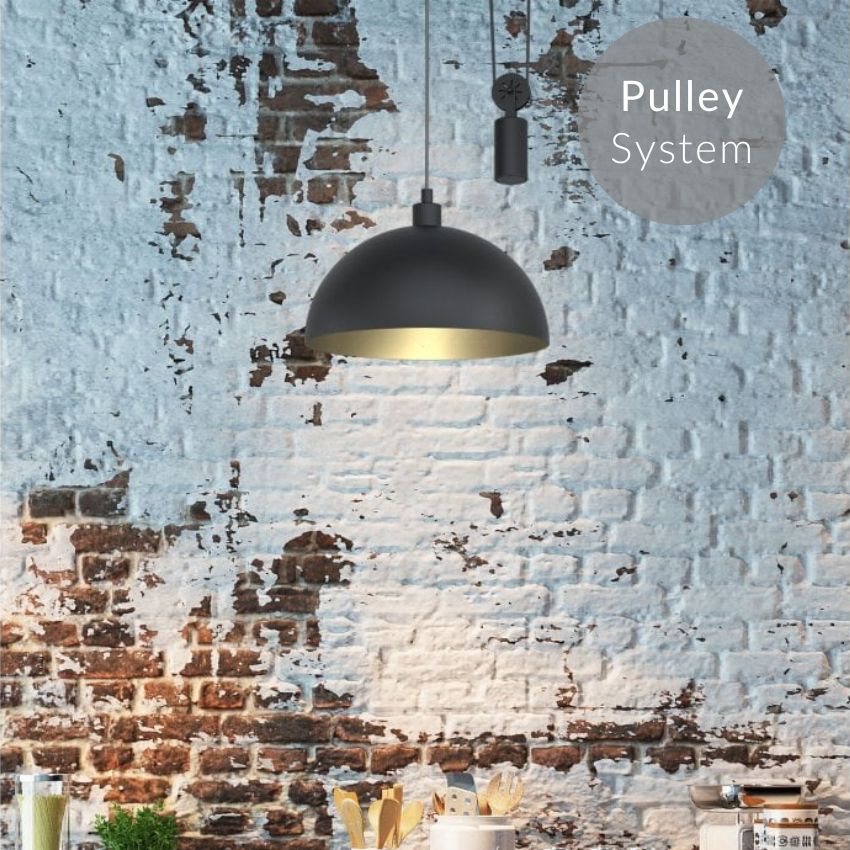
Lower and raise to adjust the light effect. Rise and fall pendant lights for all occassions.
Rise and fall pendant lights can be pulled down or pushed up to suit your needs. These lights are weighted to hold the shade at the required height. Lower the light for a more focused or intimate light, or raise it for a wider spread of ambient light. Add in a dimmer switch, and you’ll always have the right lighting!

Let’s answer a few frequently asked questions about weighted adjustable ceiling pendants:
How do rise and fall ceiling pendants work?
Rise and fall is a term used for lighting that can be pulled down over a table to focus light at a lower level to provide ambient lighting or pushed up when the light is needed more generally to light the room. I guess the effect is much like that of a dimmer switch.
There are two main types of rise and fall suspensions. One, which is the more traditional kind, is a weighted pulley system. This works where a counter balanced weight where gravity is used to displace one weight with the other the shade and a ballast or waste at the other, basically this operates much as a child’s see-saw.
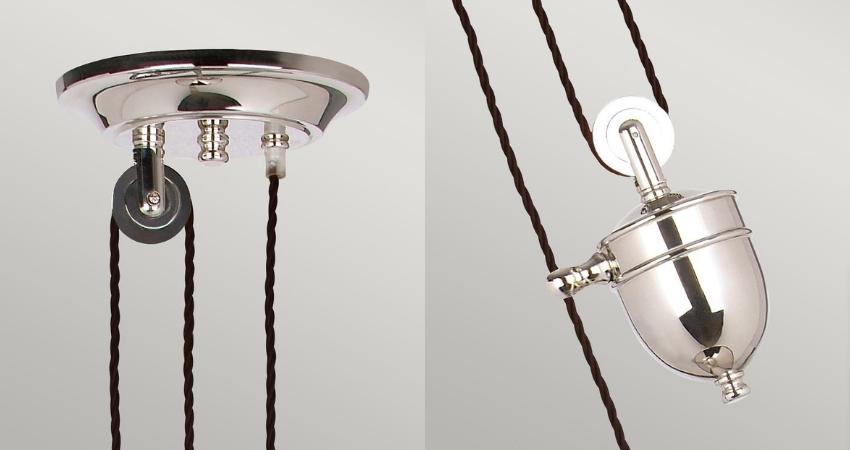
The second, is a reach cord (similar to the phone cable in the 90’s) which goes over the wire. The cable recoils when pushed upwards like a mini winch, often referred to as a recoil mechanism.

Both methods require a manual action by the user either pushing the light up or pulling it down, hence many people call such lights push me pull me lights.
Where is it best to use a rise and fall ceiling light?
Where is it best to use a rise and fall ceiling light?
Rise and fall pendant lights over a kitchen island, or a breakfast bar are ideal.
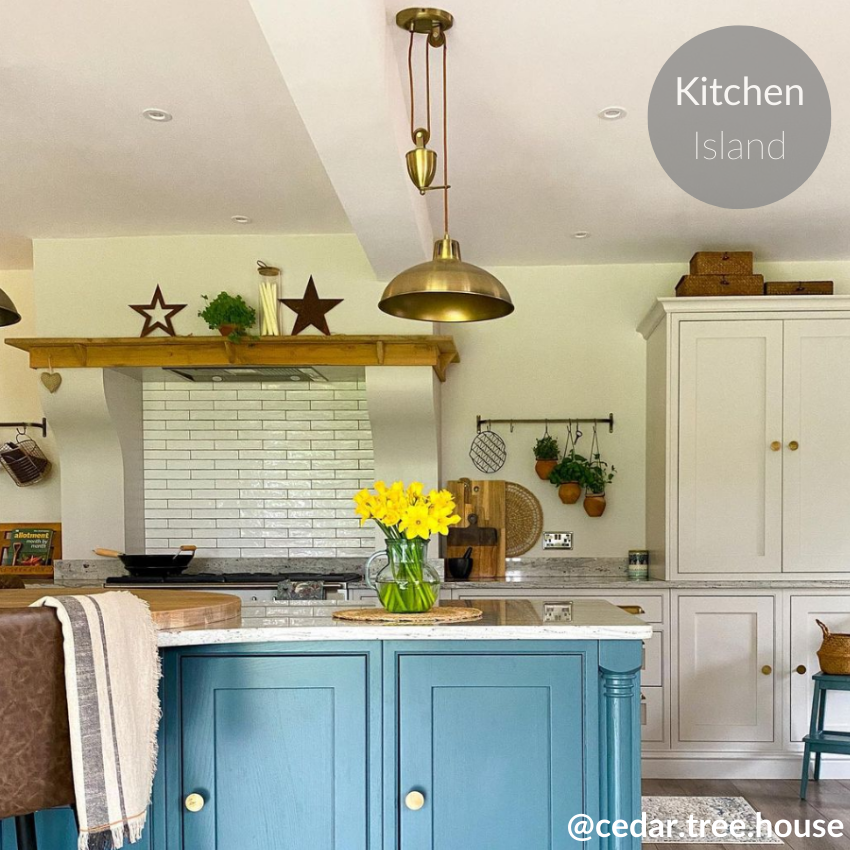
Dining rooms. These versatile spaces really benefit from this flexible form of lighting.

Where can I buy dimmable rise and fall pendants?
Rise and fall lights that are dimmable are available online here at the Lighting Company.
Make sure that you have dimmable LED bulbs and a suitable switch and you’re ready to go!
The difference in the ambience from the rise and fall being in a high position and on full brightness to a low position and dimmed is a wonder to behold. The lower setting is perfect for an intimate dinner party, where the walls disappear into the shadows to allow your dining table to be the star of the show.
What’s the ideal hanging height for a rise and fall ceiling light?
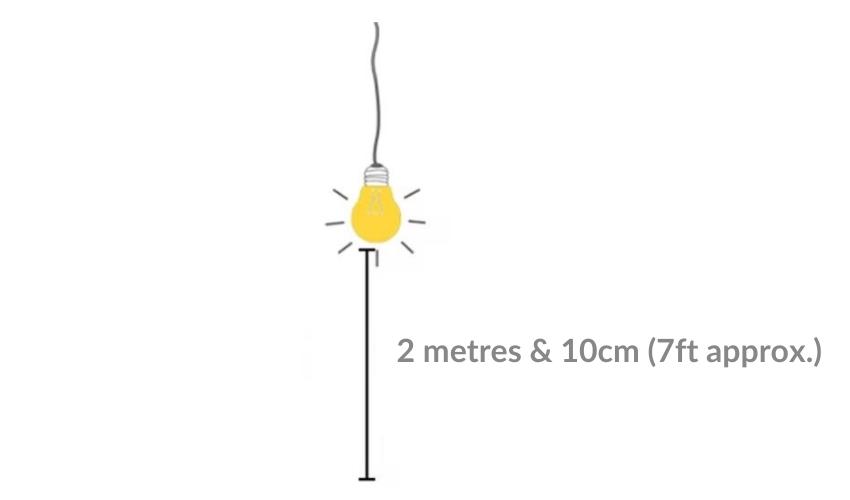
The general rule of the clearance from the bottom of the shade is to have at least 2 metres and 10 cm (approximately 7 feet). Obviously, this can be lower if it’s positioned over a coffee table or another obstacle which ensures that it won’t get walked into.
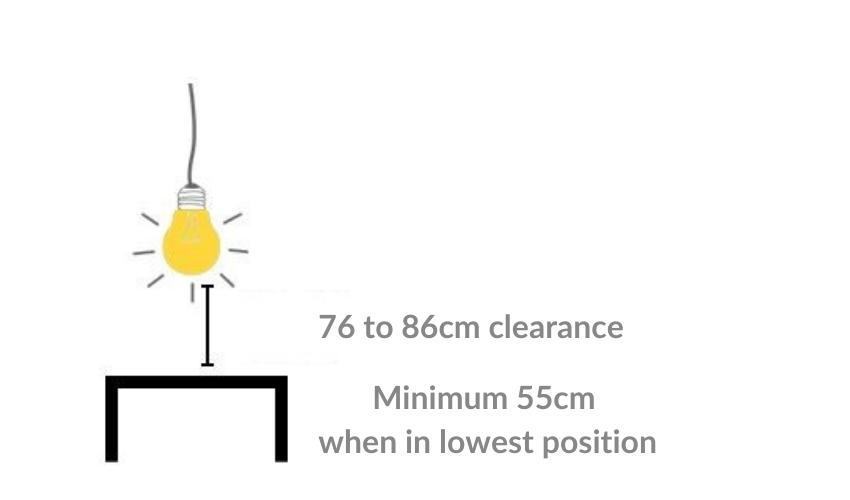
If you’re placing them over a dining table, kitchen island or breakfast bar, we’d recommend a clearance of 76 to 86cm. Obviously, the point of a rise and fall is that you can raise and lower it, so the lowest we’d recommend when pulled down is around 55cm, or in line with the tallest person at the table. You don’t want a cosy dinner party and not be able to see eachother around the light!
Does a rise and fall pendant require special installation?
Does a rise and fall pendant require special installation?
Firstly, a health and safety reminder, that all lights should be installed by a competent person or electrician. It’s good to know that there is nothing different required electrically for these types of lights.
In practical terms, you do want to ensure you have a tall enough ceiling to allow the free movement of the light being raised and lowered. Most lights can be shortened but rise and fall differ, as shortening them can effect balance or range of movement. Generally speaking, rooms with low ceiling heights are not suitable for rise and fall lighting, as much of the benefit of being able to raise and lower the light shade are lost.
Can you change the shade on a rise and fall light?
As rise and fall lights are balanced by the weight, it’s not a good idea to change the shade. On a counterweight type of rise and fall the shade and ballast weight need to be the same.
On a recoil mechanism, the curly cable types of rise and fall, there is a tension adjustment in the ceiling rose. To change the shade, you’d also adjust tension which means you are messing about where the electrics are connect. Ensure you switch off the power supply at the fuse board before attempting this. We’d advise against changing shades – it can be done on most, but not all light fittings. Take plenty of care and we’d advise consulting an electrician.
Can you use a rise and fall light on a vaulted or sloped ceilings?
Rise and fall pendant lights are therefore not recommended for sloping ceilings.
Curly cable fittings that are normally fixed to the ceiling and pulled straight down, the action allows the cable to move freely. If mounting on a slope, it will cause stress and rubbing on the cable, causing breakage over time.
With counter balance rise and fall lights, you’ll encounter the same issue, as the cable runs through a wheel at the ceiling rose. if mounted at an angle this would not allow the cable to be positioned on the wheel as it should.
We would recommend to avoid using rise and fall lights on a sloped ceiling.
Can you buy cheap rise and fall lighting?
Yes – you can! The cheapest style of rise and fall light is the recoiled cable designs. These tend to look more modern, so if you have a traditional home, you should probably save up to invest in one which is more inkeeping with your home. That said, did you know that we offer PayPal credit on our site, where you can split the payments over 3 months?
What’s a good quality rise and fall light?
The best rise and fall light for longevity would be the winched system. These are made of metal with reinforced cable for a continued smooth operation.
Can you get rise and fall lights with integral LEDs?
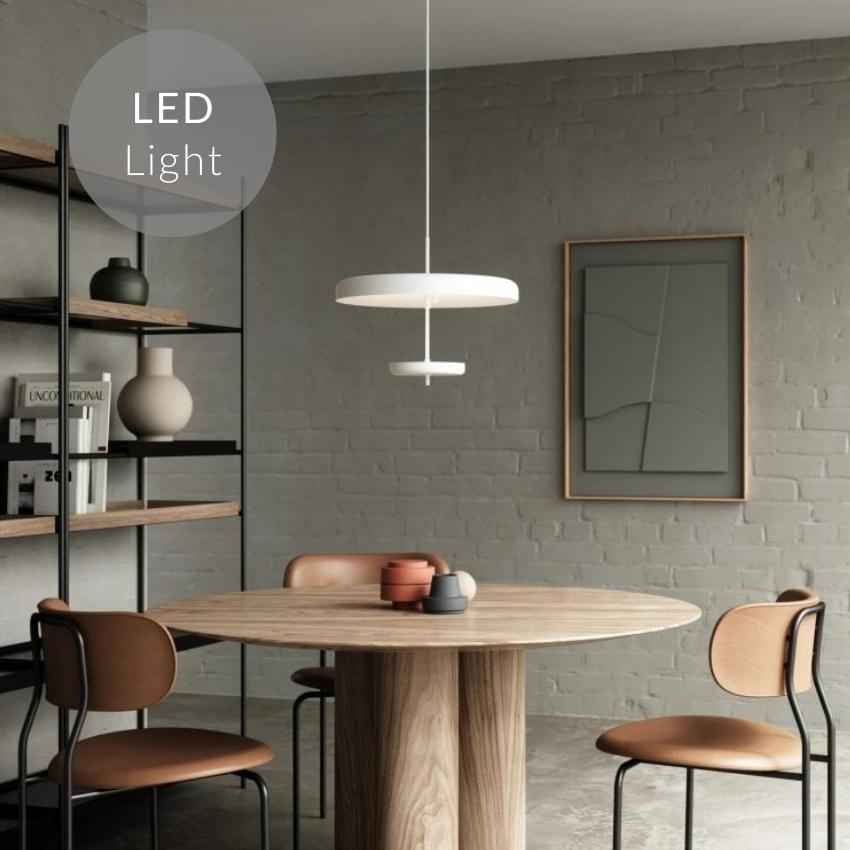
Yes! Two major design wins collide with rise and fall LED lights. They are sleek and contemporary too and come with a 2 year electrical warranty for peace of mind.
How easy is it to change a bulb in a rise and fall light?
Well, a piece of cake! Simply turn off the electrics at the fuse, lower the light down for easy reach and hey presto!
What are good rooms to use a rise and fall light in?
Rise and fall lights in a study or home office are really helpful. The changing of natural light throughout the day can pay havok with our eyes, increasing eye fatigue.
Imagine reaching up and tweaking the light above you, each time your eyes notice this subtle shift? Problem solved.
An on-trend concept is bedside pendant lighting. It’s clear to see how the aesthetics work, but now imagine that you can raise the light when you need ambient light, then lowering it after a long day to read a book. Perfect!
A desk in a teenagers or child’s bedroom will really benefit from this too. The higher position of the light will be perfect for homework and play and for bedtime tasks, such as drawing or reading, will be under the more subdued lighting effect, ready for sleep.
There really is no forbidden room to feature the versatility of a rise and fall light. Where will you use yours?