Light Bulb FAQ
We get asked many different questions about light bulbs which can be a confusing subject with different terminology being used and evolving technologies designed to make light bulbs increasingly energy efficient and to help you save money on your energy bills each month.
This FAQ page will cover everything from all your concerns and questions about LED bulbs, what Kelvin and Colour Temperature of light bulbs mean for you and how to work out just how much light your room needs.
Our website is also designed to present a variety of suitable LED bulbs when you put a light fitting into your basket to make it as easy as possible for you.
If for any reason your question isn't covered here then please get in tough with our expert, helpful team!
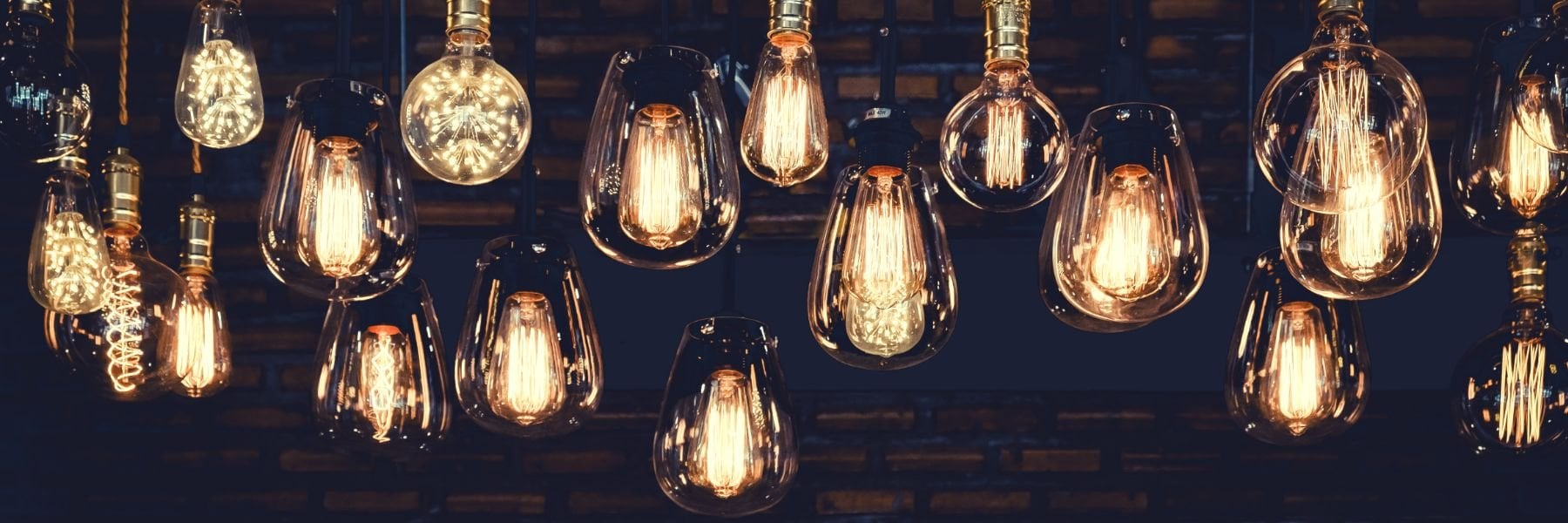
Low energy use bulbs don't need to be ugly, dim or not decorative. Many people still think of low energy bulbs being like the first iterations of low energy bulb that were spiral fluorescent types. These were not very bright, dimmed over time and looked very ugly!
Modern LED bulbs are available for almost every single case and can look just like an old incandescent style bulb but with massive savings in energy usage, Great for the environment and your pockets. Costs in recent years have continued to fall for these LED and although they cost slightly more the bulbs did "back in the day" they will save you between 75% and 90% on running your lighting compared to old style incandescent and halogen bulbs.
Choose from one of our Light Bulb FAQ's:
What are the advantages of LED Lighting?
The major advantage of LED lighting is, without question, the lower power usage. Led lights meet all of the governments' bans and initiatives to lessen our carbon footprint.
The efficiency of contemporary LED light bulbs is 5-6 times greater than that of regular incandescent bulbs, which means that LED bulbs consume only 1/6th of the energy to generate the same amount of light because LED lights direct the majority of their light to where it is required, they can be up to ten times more effective in certain situations, lowering energy consumption by up to 90%.
LED lights are not only more efficient, but they also live much longer than incandescent bulbs.
LED bulbs have a lifespan ranging from 40k to 100k hours. Even at 40k hours, this is 4.5 years of continuous operation, implying that these bulbs will last for more than 10 years under normal conditions.
LED spotlights last up to 24 times longer than halogen bulbs. LED bulbs do not burn out like ordinary bulbs, instead, the light output steadily decreases. The lifespan is determined by the time it takes for the bulb to lose 70% of its initial output, albeit the bulb continues to function after this point.
LED lightbulbs are environmentally friendly, they are free of hazardous mercury, emit no C01, and can be recycled without damaging the environment.
They do not emit UV radiation. LED bulbs are cool to the touch because they approach 90% efficiency, which means that 90% of the energy is turned to light and only 10% is lost as heat energy.
In comparison, an incandescent bulb loses 80% of its electrical energy as heat, making these lights extremely hot to touch,
Finally, LED lights illuminate fully, perform when switched on and off often, may be used with a dimmer controller and there is also no buzzing or flickering.
The most significant advantage of LED technology is its long lifespan. These lights will outlast standard bulbs, with lifespans of up to 50,000 hours.
LED lights can be installed and then forgotten about, as they may not need to be replaced for 10-20 years.
In comparison, incandescent bulbs and halogen bulbs have a lifespan of 1,000 to 2,000 hours, requiring you to spend a significant amount of time up a ladder replacing them!
LED lights are mercury-free, as opposed to fluorescent lighting, which includes mercury and other toxic substances that can be harmful to the environment.
Furthermore, LED lighting is completely recyclable. One LED bulb saves the material and energy required to manufacture up to 25 incandescent lamps.
As a result, is considered an environmentally friendly lighting solution.
LED lights feature exceptional design flexibility, allowing for controllable illumination.
These lights are efficient and unique due to the dynamic control of light, distribution, and colour.
With its wonderful lighting effects, such lighting can set the mood and ambience beautifully.
Furthermore, these lights have a unique form that provides fantastic illumination.
Where can I use LED Light Bulbs?
LEDs can be used anywhere, other forms of lighting are used and are suitable for both indoor and outdoor spaces.
They are best used where directional lighting is needed - spotlighting for bathrooms and kitchen, flood lights, track lighting and reading lighting etc.
They are also a good choice where lights will be left on for long periods e.g shop windows, exterior garden lights and more.
The long life of LED lights makes them a perfect choice where access to maintenance is difficult.
Low-level LED lights can be used for mood or accent lighting and are ideal for lighting plinths in kitchens, for inserting into stairs or for use under shelves.
For outdoor use, LED lights can be recessed into decking, used around or inside swimming pools, for lighting driveways or pathways or even to highlight garden features.
LEDs are available in a number of different colours. Warm white and cool white tend to be the most popular but there are blue yellow, green, red and colour-changing options as well.
Have a look at the possibilities and be truly inspired.
View our selection of LED bulbs.
How bright are LED Bulbs?
Modern LED's are completely comparable to the incandescent bulbs that they have replaced with regard to brightness.
However, not all LED bulbs are made the same or to the same specification. We sell the highest quality LED bulbs with our products.
An old 60W bulb would give around 600 lumens of light and that can be expected of a 6W to 8W LED bulb although check the lumen output on check the size and details.
We prefer to supply dimmable version of the bulbs for the maximum in control, these can be used with or without a compatible dimmer switch but with a dimmer it gives control over the levels of light particularly import where multiple tasks are undertaken in a room.
For those with poor eyesight or those with specific needs, we have 18W bulbs with up to 1600 lumens of output. A bright enough bulb for any circumstances.
Pay attention when buying bulbs for fittings with more than one light as you may wish to choose a slightly lower output and the total output of all bulbs needs to be calculated for overall brightness.
Other considerations are the glass or shade on a fitting which may direct or limit the light coming form any fitting.
What are Lumens?
We are often asked what are lumens and why can't I just use an old style 100W bulb?
Lumens are used in LED lighting to measure the brightness of a bulb.
This is not the same as Watts, which measure the amount of energy a light bulb uses
The term Lumen literally means 'Light.' Which makes sense when you consider what it is measuring.
Lumens, in other words, measure the quantity of light emitted by your LED bulb.
The larger the number of Lumens, the brighter the light produced.
When searching for LED lights, one term that will come up frequently is 'Lumen'.
In reality, Lumen ratings are frequently listed first on any information panel of an LED light.
Lumens are an important lighting parameter, and understanding them can help you choose the proper lighting for your purpose.
Here's an explanation of what this phrase implies and how it influences your lighting selections
Why Are LED Lights Measured In Lumens?
Measuring the brightness of a light is more important than measuring its power.
Traditional incandescent bulbs were measured in watts, which showed how much power they use.
More wattage meant a brighter light. Now that the industry has so many energy-efficient lighting options, more wattage does not actually mean more light, unless you are staying within the same type of bulb.
That is why LED lighting is measured in Lumens.
Lumens are a particularly helpful unit when trying to calculate how many lights to buy for your room or living space.
Most rooms have a minimum requirement for proper visibility, and you can only calculate how many lights you need if you calculate this in Lumens.
If you need a particular number of Lumens per square foot and know how many Lumens the light produces, you can install or purchase the correct number of lights for the purposes required.
Lumen Levels for Specifics Rooms
What amount of lumens are required for certain rooms?
Bathroom Lighting
The bathroom is the room that requires the most light.
When you shave or wash your teeth, you want to be sure you have enough vision!
It is advised that you have between 2000 and 4000 lumens in this space.
Depending on your preference, it can have one or more light sources.
You should also get a fixture with the appropriate IP rating. The IP rating of a lamp indicates its resistance to dampness and dust.
Living Room Lighting
The number of lumens required for the living room differs from that required for the TV area and the dining area.
For the TV area, you don't need a high luminosity. Instead, we propose using adjustable LED lights so that you may choose the ideal mood for each moment.
You'll need between 1500 and 3000 lumens for the TV area.
You'll need a little extra oomph for the dining area. Once again, dimmable LED lights are the ideal option. This room requires between 3000 and 6000 lumens.
Bedroom Lighting
To determine how many lumens are needed in the bedroom, first determine whether it has a desk or large furniture, such as a high drawer.
If you have children, they may also spend a significant amount of time in their room studying. In this particular scenario, a lot of light is required. We recommend a total lumen amount of 2000 to 4000.
You can see the number of lumens on our products; make sure to choose the proper one for the room in order to create the optimal ambience.
Also, make sure to select the appropriate colour temperature, as this can have an impact on the overall appearance of a room. If you want to learn more about this check out our FAQ on Kelvin and Colour Temperature.
Kitchen Lighting
The kitchen is one of the most significant rooms in your home, as it is where many activities take place.
As a result, having the proper amount of light is critical. To begin with, you must have a light source above your table.
You must then ensure that there are lights above the kitchen work area and burners.
Lighting with a luminous output of 2000 to 4000 is required to create that perfect ambience for your kitchen.
What are Kelvins and what does Colour Temperature mean
Have you ever bought a new light bulb expecting it to produce the same warm, yellow light as the old one, only to be disappointed when it produces a much brighter, whiter light? You probably didn't think to check the colour temperature of the bulb before buying it.
When thinking about switching to LED lighting nothing is as discouraging as selecting the wrong colour bulb. Let's look at what colour temperature is and how it influences your lighting decisions.
What does Kelvin really mean?
From the warm, gentle glow of a candle to the dazzling blue beam of a street light, each light source has its own personality. One aspect of that character is brightness, which is measured in Lumens; the other aspect is colour temperature, which is measured in degrees Kelvin. Hue temperature refers to the colour of the light generated by the bulb rather than the ambient hot/cold temperature of our surroundings.
The lower the colour temperature, the warmer the light, and the higher the colour temperature, the cooler the light. A light bulb with a colour temperature of 5000K, for example, will produce light that is closer to the brilliance of the sun than a bulb with a 2700K colour temperature.

Warm Colour Temperatures (2000K to 3500K)
Warm lights have colour temperatures ranging from 2700K to 3500K. People tend to decorate their homes in warm earth tones—reds, oranges, and yellows—which warm light intensifies, so most homes appear best in warm-toned light. Warm light, which is softer and gentler on the eyes than bright, cool-toned light, is frequently utilised in bedrooms, dining rooms, and living rooms to create a warm ambiance. Restaurants are another place to look for softer lighting. A restaurant serving dinner visitors, for example, would use softer, more orange lighting to create a welcoming atmosphere. Furthermore, warm light makes people look better.
Cool Colour Temperatures (4000K to 4500K)
While the residential standard is warm colour temperatures, some people prefer higher or "cooler" colour temperatures. Color temperatures of 4000K or higher are commonly utilised as task lighting in workplaces, kitchen under-cabinet lighting, and craft areas due to the neutral tone. Furthermore, higher colour temperatures are generally perceived as brighter than warmer temperatures, whereas cooler light is perceived as "cleaner." Imperfections and colour variations between items are more visible in cool white light. While this isn't always optimal, it's useful for things like makeup lighting or general lighting in places where cleanliness is a must.
Full Spectrum Color (5000K to 6500K)
Extremely high colour temperatures, sometimes known as "full spectrum" or "daylight," are less common. Hue temperatures ranging from 5000K to 6500K are close to the colour of a bright, sunny day. Some folks may find the light to have a strong blue cast that appears harsh. Colour temperatures in this range are uncommon in houses, save in garages or home offices. Outside of the house, there is a trend toward putting "full spectrum" bulbs in companies, which are occasionally connected with increased productivity. Museums, jewellery stores, display windows, and hospitals are some more places that use full spectrum illumination.
Colour Temperature and Perception
While colour temperature is crucial for generating atmosphere in a space, it may also have a significant impact on the appearance of your walls or furnishings. Installing warm light in a room painted in cool-toned colours might lead your room to look faded and dull, and the opposite is true for installing cool light in a room decorated in warm-toned colours. This happens for the same reason that sometimes you buy something at the store that you thought was black only to realise it's actually navy in natural light. Colour is affected by the colour temperature and overall quality of your lighting, a phenomena known as metamerism.
Making Your Decision
It is critical to understand the purpose of your next bulb before acquiring it. Nothing may sour your opinion of LED illumination like purchasing a 4000K or 5000K bulb when you intended to get a 2700K bulb, or vice versa.
This is why, whenever you buy a new, energy-efficient bulb, you should always check the colour temperature. Consider your application and colour palette carefully before purchasing a bulb with the appropriate colour temperature and/or brightness.
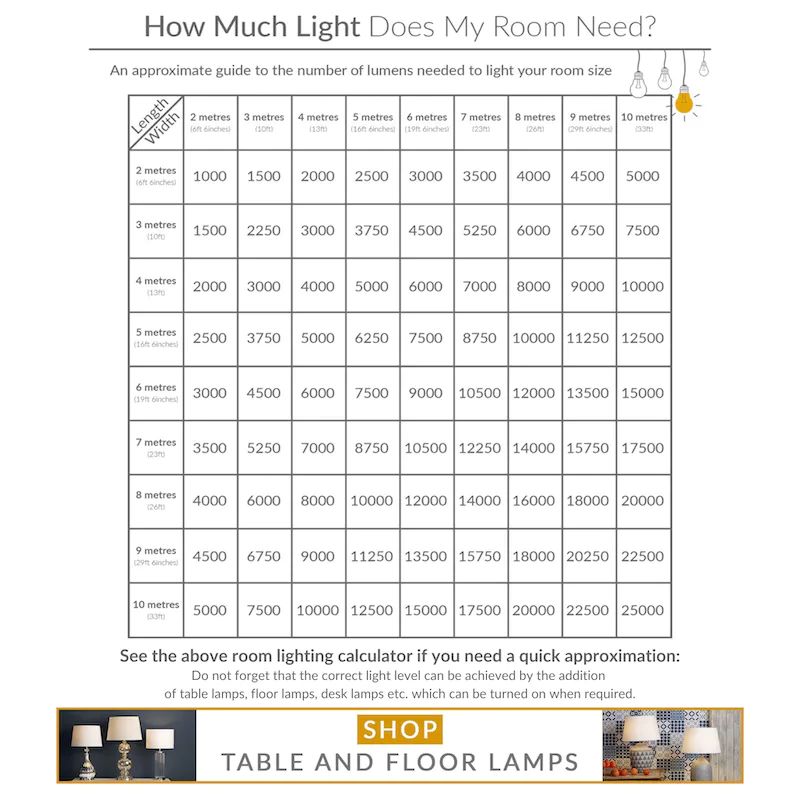
How Much Light Does My Room Need?
As a basic guide to determining the level of light, you need to calculate your room size in square metres and multiply by
250.
For example, if your room measures 4m x 5m it has an area of 20 square metres. If you are using conventional bulbs, multiply this by 25, giving a total wattage of 500 watts, or a light level of around 5000 lumens is required.
The lumen level of each bulb will vary depending on the type of bulb and manufacturer, check the specific lumen level of each bulb to measure up with the overall target light level.
As a basic guide to determining the level of light, you need to calculate your room size in square metres and multiply by
250.
For example, if your room measures 4m x 5m it has an area of
20 square metres. If you are using conventional bulbs, multiply this by 25, giving a total wattage of 500 watts, or a light level of around 5000 lumens is required.
The lumen level of each bulb will vary depending on the type of bulb and manufacturer, check the specific lumen level of each bulb to measure up with the overall target light level.